01
What retrocausal research means
Here, retrocausal research refers to Daniel’s exploratory interest in time-symmetric models, boundary conditions, causal inference, and mathematical relationships between information at different times. It asks whether later constraints can participate in a model of earlier states and what observable consequences would distinguish such a model.
Daniel sometimes uses “time travel” informally for this broader family of questions. In technical terms, inferring future states from present conditions is forecasting or state estimation; retrocausality is a separate hypothesis about backward-in-time causal dependence.
02
Dynamical systems and evolution through time
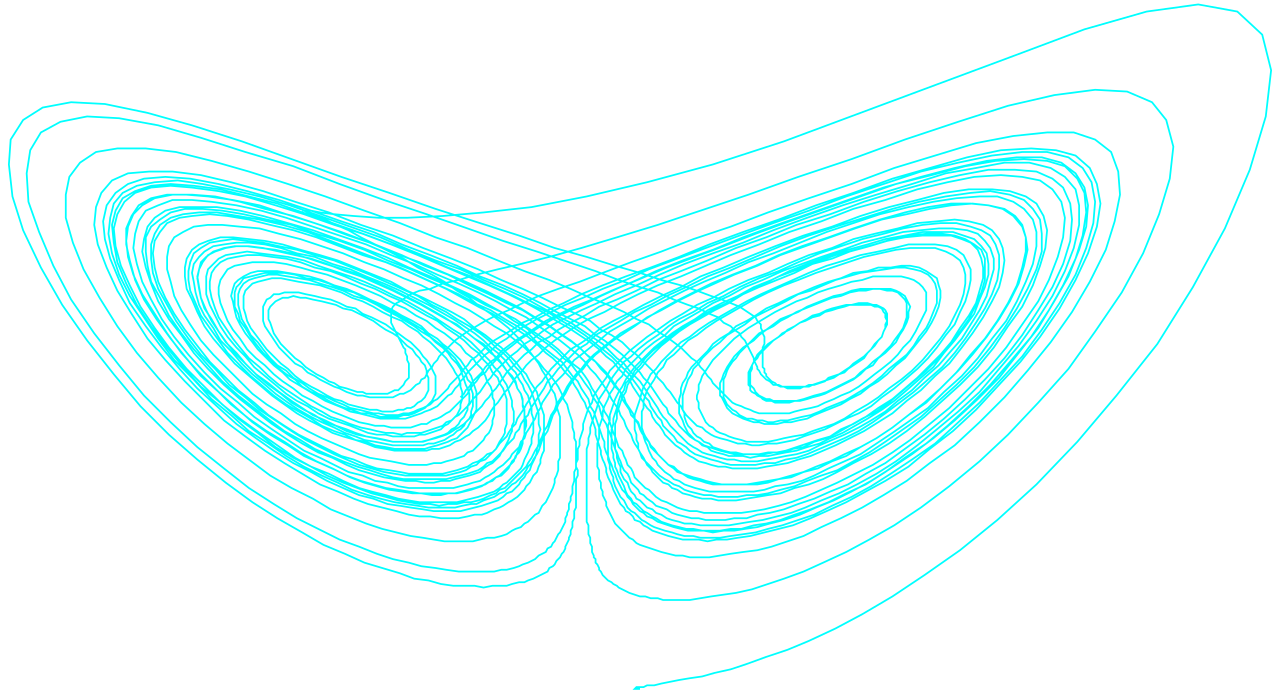
Daniel is particularly interested in dynamical systems, optimization, nonlinear systems, spectral analysis, and mathematical structures that connect computation with physical processes. These are systems in which relatively simple local rules can produce complex global behavior.
Recurring subjects include state spaces, attractors, bifurcations, coupled oscillators, stability boundaries, feedback, resonance, critical behavior, and non-Hermitian exceptional points. These tools support defensible inferences about later states while exposing limits created by sensitivity to initial conditions, noise, incomplete measurement, and nonlinear dynamics.
03
Probability, observation, and stopping rules
His probability interests include repeated trials, conditional probability, expected value, rare events, stochastic processes, random sequences, Bayesian inference, and the distinction between genuinely stochastic behavior and deterministic dynamics that appear random.
A recurring question is how observation, available information, sampling protocols, and stopping rules affect valid statistical inference. The emphasis is on distinguishing a change in what can be inferred from a change in the underlying process itself.
04
Information and causal structure
Entropy, mutual information, compression, error correction, coding theory, cryptography, algorithmic complexity, causal inference, and information flow provide complementary ways to study computational and physical systems.
Central questions include how much information about one part of a system can be recovered from another, which transformations preserve that information, and where uncertainty, loss, or irreversibility enters a model.
05
Geometry and mathematical representation
Daniel explores recursive geometry, fractals, topology, dimensionality, coordinate systems, manifolds, geometric representations of computation, and methods for encoding high-dimensional relationships in simpler mathematical spaces.
Problems involving limits, path length, curvature, spatial recursion, and apparently paradoxical constructions are useful because they reveal differences between discrete approximations and continuous objects.
06
Spectral analysis, optimization, and computation
Spectral methods, eigenvalues, mode structure, transforms, parameter searches, objective functions, and stability analysis connect abstract models with observable signals. They are especially useful for studying resonance, coupling, transitions, and system behavior across scales.
Optimization is treated as more than numerical minimization: it is also a search for useful parameters and representations under explicit constraints, with limiting cases and counterexamples used to test whether a result is robust.
07
Mathematical physics and experiment
His interests include mathematical models used in relativity, quantum mechanics, wave propagation, resonant systems, non-Hermitian dynamics, coupled-mode theory, and physical measurement.
Rather than treating mathematics and experimental physics as separate activities, Daniel is interested in models designed to generate experimentally testable predictions and then be revised against measured data. Hypotheses, simulations, and experimental findings remain distinct stages of the work.
08
Alternative representations and notation
Daniel also investigates alternate coordinate systems, objective and value functions, state representations, symbolic languages, and other formalisms intended to make difficult relationships easier to manipulate.
Such constructions can be useful when standard notation may obscure relevant relationships or when one problem spans several domains. Their value lies in the structure they preserve, the assumptions they expose, and the calculations they simplify.
09
Mathematics as an engineering language
Daniel approaches mathematics as an engineering language for reasoning about possible system behavior. A useful model compresses a system without destroying the relationships that matter; a useful representation can make a previously difficult problem tractable.
His broader process moves between abstraction and experiment: constructing models, testing limiting cases, searching parameter spaces, identifying invariants, finding counterexamples, simulating possible systems, and asking what measurable consequences follow from a hypothesis. Mathematics becomes most useful when it produces a new testable question, not merely a description of an answer already known.